
Manchego Anejo 150g
About This Cheese
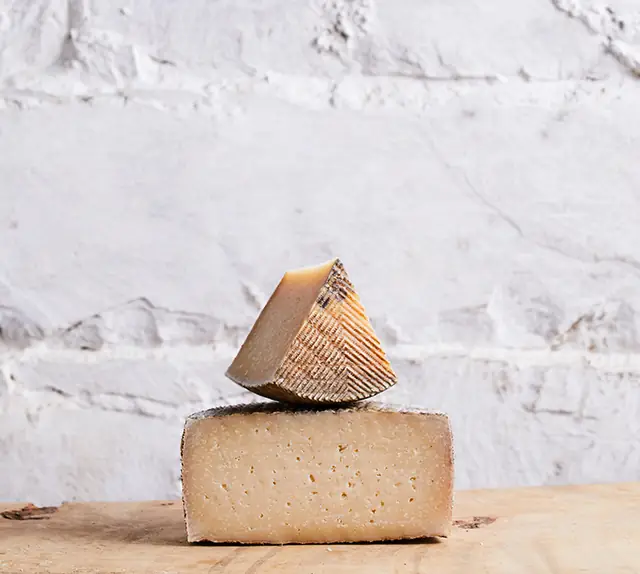
Aged Manchego has a rich, slightly acidic flavour with subtle aromas of nuts and dried hay. The rind is a rich chestnut colour and the interior is flaky and dense.
TypeHard
Rennettraditional
RegionLa mancha, Spain
Producerartequeso
Milkewe, raw ewe
RindN/A
€6.30

Story
This Manchego Viejo matured at a minimum of 12 months, but is often 18 months old. This extra aging produces a stronger flavour, harder paste, and a bolder bite than its younger counter part. Our Manchego is produced on the La Prudenciana farm by the Alvarez Valera Family, located in the heart of La Mancha region, in Tembleque, Toledo.
Producer
In the early 1950s, Alfonso Anastasio Valera, married Heródita del Carmen. Together they combined their land which became home to their present day family farm La Prudenciana, named in honor of Heródita's mother. The farm was historically used for various agricultural pursuits until Manchego cheese designated PDO in 1980 at which time the family changed gears and began producing Manchego cheese. Since then, the sheep dairy farm has been passed down through family members through to present day where they continue to make some of the best cheese in Spain. The farm is home to 8,000 Manchego sheep whose raw milk produces fantastic Manchego using artisan methods and PDO adherence.
Goes Well With


You may also like…
FAQs
Cheese should be unpacked and stored in a cool place, ideally around 5 degrees. Take out about an hour before serving, and allow to come to room temperature. Leaving cheese come up to room temperature (“to chambre”) allows it to develop a fuller, more aromatic flavour. Beware temperatures that are too warm (hot kitchen) and try and let the cheese come up to temperature in a relatively cool place like a cool pantry. Harder cheeses can need a little more time than softer ones.
Cheeses like cheddars that have more open texture pastes where the curd is not heavily compacted during the cheesemaking process can have occasional blue veining. Though this blueing is caused by unintentional rouge pencillium genus mould that has found its way into the cheese, it is often sought after for its contributing flavour.
Frequently, cheeses that start to grow mould while aging, in storage, or during transit can be salvaged and are safe to consume. In the case of blue/white mould that has begun to form, it can be scraped off with regular dinner knife or back of chef knife, and bloomy rind cheeses often begin to re-rind themselves on the cut surface which can just be cut off or eaten.
Spoiled cheese has some key indicators – if you get an ammonia/sour smell or taste then it goes in the bin.
Fresh, high moisture, young cheeses (think mozzarella/ricotta/mascarpone/cream cheese) that have mould growing should be discarded immediately.
Moulds that show up with black or reddish hue should be discarded.
Our primary aim is to provide delicious, quality, safe cheeses to our Sheridans customers however cheese is a living thing with an agenda of its own. If you believe your cheese (or other food item) has spoiled, please contact us immediate at online@sheridanscheesemongers.com for a replacement or refund.
Nutritional Information
Ingredients. Manchega sheep raw milk (98 %) salt (2 %) animal rennet, lysozyme of egg (E-1105) and lactic
ferments.(traces)
Allergens in bold
Nutritional facts in 100 gr.
Regulator Council facts
Water: 30 – 28 gr.
Dry extract: 70 – 82 gr. Minimum 55 %
Energy 443 Kcal.
Proteins 24 gr.
Total fats 37,9 gr.
Saturated fatty acids 33, 7 gr.
Monounsaturated fatty acids: 9, 7 gr.
Polyunsaturated fatty acids 1, 0 gr.
Trans fatty acids 0, 66 gr.
Cholesterol: 91 mg
Carbohydrates: 0, 7 gr.
Salt 1, 7 gr. Maximum 2, 3 gr.
Calcium: 797 mg.
Sodium: 820 mg